A Quiet Revolution in Retail: How Parametric Standardization and Local Data Return Power to the Consumer
Modern retail is built on total information asymmetry. Retailers, marketplaces, and data brokers know everything about the buyer, forming closed ecosystems where the main commodity is not the items themselves, but personal data and predictable consumer behavior. However, an alternative architecture is emerging on the horizon—a decentralized system that shifts the center of purchase management from corporate cloud servers to the consumer's local storage.
The Illusion of Information: Why the GS1 (EAN-13) Standard Works Against the Buyer
There is a persistent misconception that the official GS1 barcode system carries comprehensive product information and is useful to the consumer. In reality, this standard serves exclusively warehouse logistics and cash register operations, leaving the buyer in an information vacuum.
- The "Blind" Code and Closed Databases: By itself, EAN-13 contains no useful consumer characteristics. Manufacturer databases are often closed to external systems or lack basic information. It is impossible to select or filter a product by desired parameters using EAN-13.
- The Information Hole of Weighed Goods: Barcodes printed on supermarket electronic scales hide the essence of the product, leaving only the weight and an internal store SKU.
The Parametric Solution: Code as a Carrier of Meaning
In the proposed decentralized system, the product code ceases to be a warehouse number and becomes a key to a structured matrix of knowledge. A strict set of data is attached to the code: the semantic product name code, a list of parameters, and precise values for a specific unit. This allows for precise filtering (e.g., sneakers, size 40, blue, within a 1 km radius), and for weighed goods—obtaining the real characteristics of a specific product, rather than just the supermarket's internal SKU.
System Architecture and Interaction
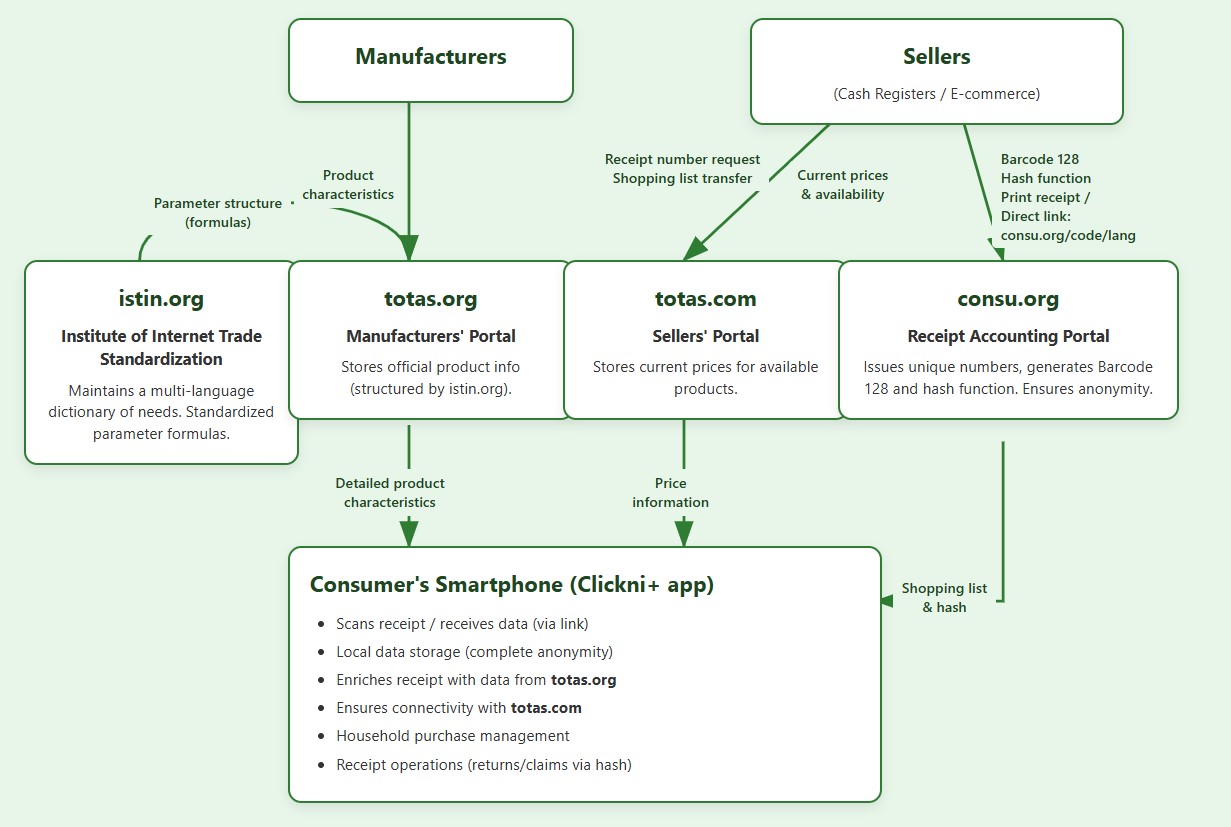
The proposed ecosystem eliminates the data monopoly by dividing information flows among specialized, independent portals and transferring the assembly point to the user's smartphone.
- istin.org (Institute of Internet Trade Standardization): Maintains, improves, and expands the multi-language "dictionary of needs" (parametric model). The dictionary contains standardized formulas for parameter names characteristic of various types of products.
- totas.org (Manufacturers' Portal): Stores official product information directly from manufacturers. All data is strictly structured using the dictionary and formulas from istin.org.
- totas.com (Sellers' Portal): A price offer aggregator. Stores up-to-date information on prices for products available from sellers.
- consu.org (Receipt Accounting Portal): Issues unique numbers to cash registers. Generates barcodes (Code 128 standard) or digital shopping list data along with the hash function of the complete receipt.
- Consumer's Smartphone with the Clickni+ app: Scans the receipt barcode or receives data via a link (consu.org/code/lang). Enriches the basic receipt with detailed data from totas.org and prices from totas.com. Enables receipt operations (returns, claims) via the hash function.
Principle of Confidentiality and Local Management
- Complete Anonymity: Neither the seller's website, nor the consu.org portal, nor the buyer's smartphone ever store the buyer's personal data or the legal data of the cash register.
- Local Management (Local-first): The entire history and complete list of purchases end up exclusively in the local database on the smartphone. The user gets complete freedom to manipulate this data in their household (e.g., distributing purchases to the fridge, freezer, tracking warranties) without marketers and merchandisers.
Balance of Power: Opponents and Drivers of Implementation
Main Opponents (Who Dislikes Transparency)
- Traditional Retail and Marketers: The system kills impulse sales and emotional pushing, while anonymity deprives stores of the ability to build client profiles (CRM).
- Large Marketplaces: Loss of the monopoly on user behavior data.
- Data Brokers: The destruction of the targeting industry and the resale of receipt analytics.
- Manufacturers of artificially overpriced goods: Strict standardization exposes real characteristics, destroying the markup for the "brand."
Drivers of Implementation (System Users)
- Manufacturers (including small businesses): Get direct contact with the consumer through the correct filling of semantic tables (the dictionary of needs), bypassing the fee for marketing "golden shelves."
- Small Sellers: Can easily create price lists by linking their prices to existing product codes in the database, and use simple cash registers with QR codes.
- Consumers: Gain a household management tool. The receipt turns into a machine-readable instruction for inventory in the Clickni+ app, ensuring conscious consumption and full control over their purchases.